
Suno Review 2026: We Tested a Real Song, End to End


Quick Verdict
// Hands-on testedTeknexia AI Tool Evaluation Framework
Scored against our site-wide 5-criteria framework, from our own hands-on generation of a full song on a real Suno account, combined with Suno's public pricing page for the tiers and tools we didn't test directly. This is the canonical score for Suno — the first entry in our new AI Audio category.
Overall: 7.0/ 10
Suno is an AI music generation platform that turns a text prompt into a full, structured song, vocals included. We tested it directly: one detailed prompt, submitted through the live app on an active account, checked against Suno's own pricing page for the tiers and tools we didn't use ourselves. This is the first review in our new AI Audio category, and it's labeled Hands-on tested for the parts we verified directly.
- Our own test song, an uplifting cinematic-electronic track with a full verse/chorus/bridge structure, generated in about a minute and largely matched a long, detailed brief (Teknexia Hub testing, August 2026).
- Suno is best understood as two different tools in one: strong for idea generation and musical prototyping, not yet strong enough for a finished, professional master, in our own direct experience.
- The mix lacked precision and the vocals leaned robotic in places on our test track — real limitations, not edge cases we had to hunt for.
- We could not find a working way to separate our track into individual stems in our test account, which limits how far you can take a Suno song into a traditional production workflow.
What We Tested, and What Happened
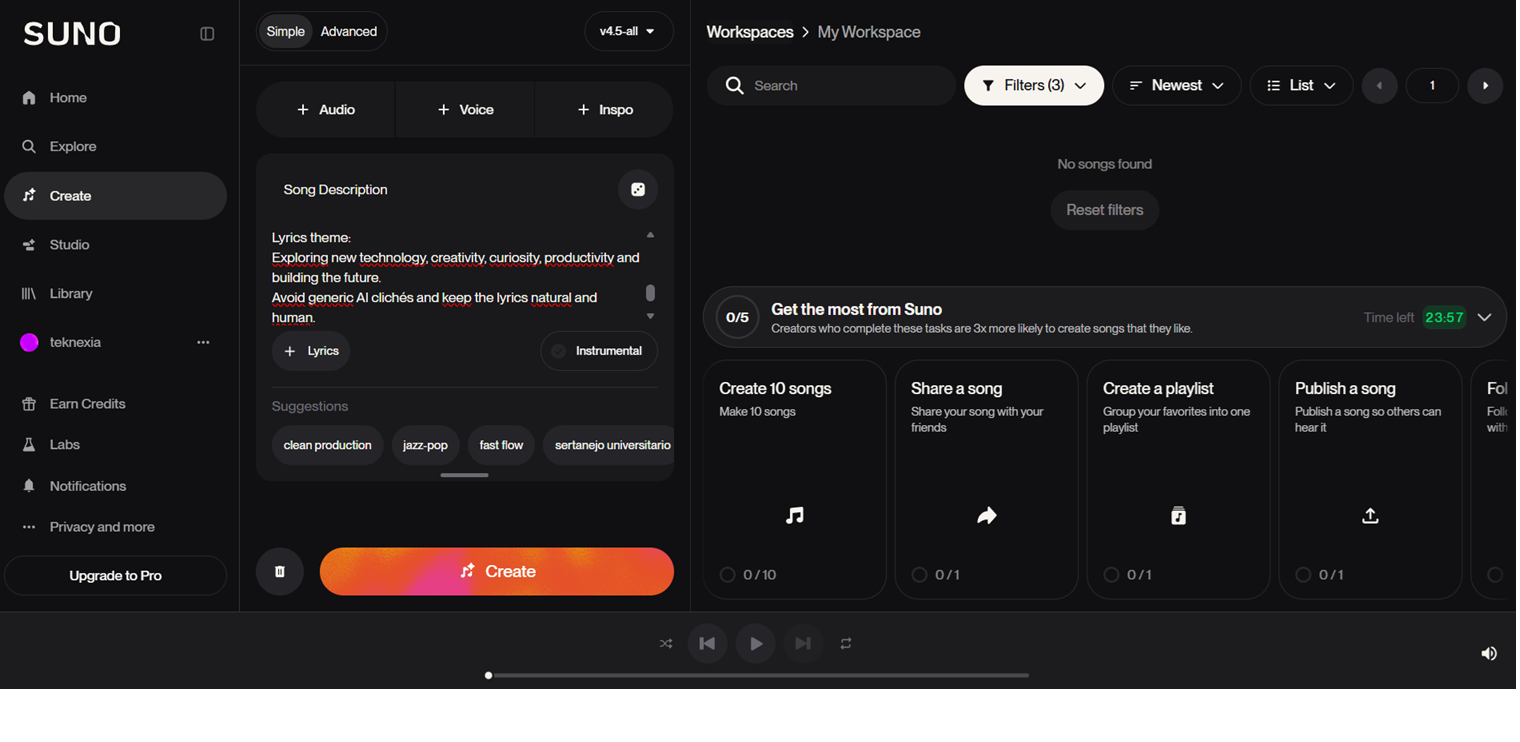
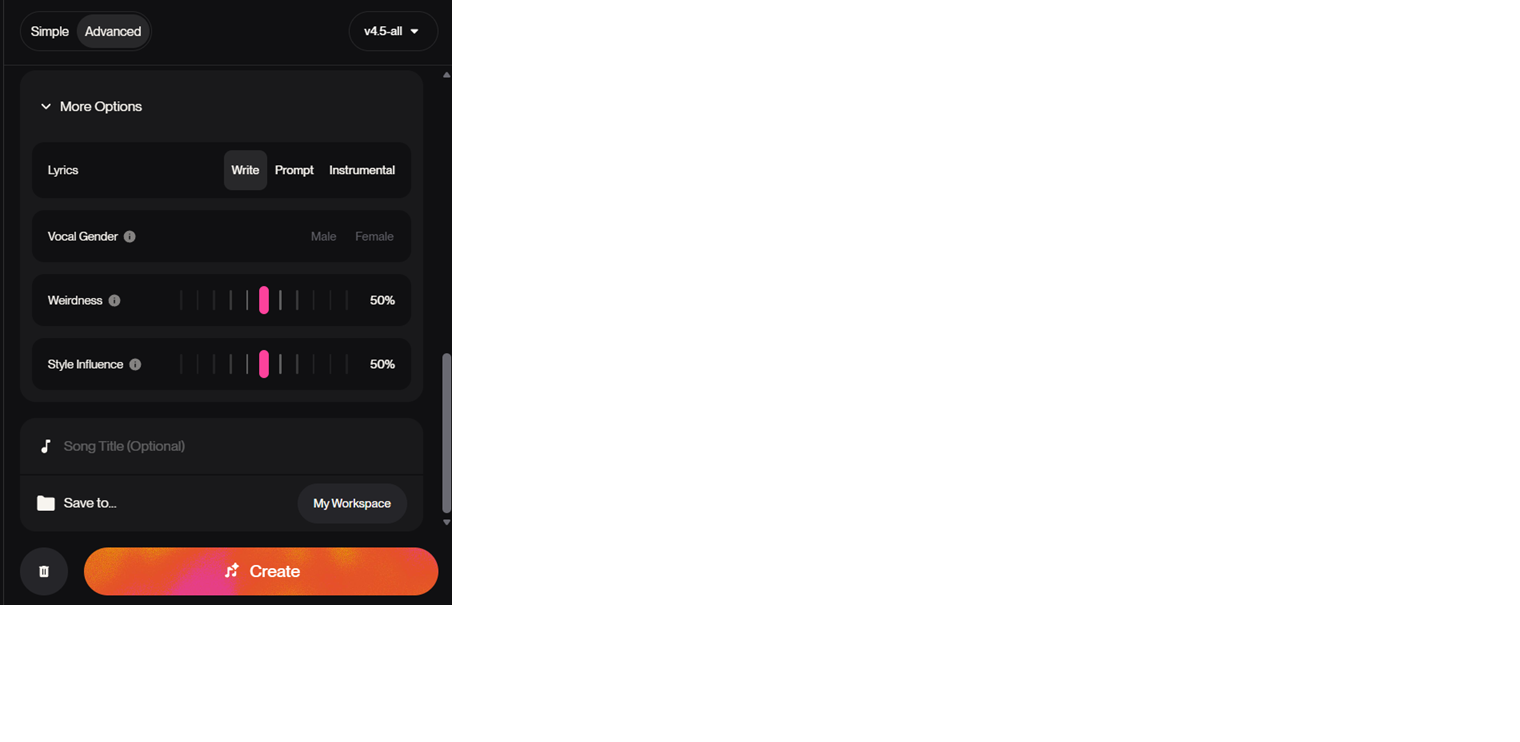
We ran this test on an active Suno account, the same starting point most new users would have. We wrote one long, specific brief: an uplifting cinematic electronic track about discovering new possibilities through AI and technology, modern electronic pop with atmospheric synths, warm piano and subtle guitar, a full intro-verse-pre-chorus-chorus-verse-chorus-bridge-chorus-outro structure, warm expressive male vocals, and an explicit instruction to avoid generic AI clichés and keep the lyrics natural.
The generation took about a minute, maybe a little longer. What came back was a complete, structured song that followed the requested arrangement and stayed close to the mood we asked for: inspirational and energetic without tipping into aggressive. As a musical idea and a starting point, it delivered. Listening critically, two things gave it away as AI-made rather than studio-produced: the mix didn't have the separation and precision a human engineer would give it, and the vocals, while clear and largely in tune, leaned robotic in a few places rather than fully human.
Our Test Protocol
These notes document what we did during testing — they are separate from the 5-criteria Teknexia AI Tool Evaluation Framework score in the Quick Verdict above, not a replacement or duplicate of it.
| Test | Prompt | Result | Note |
|---|---|---|---|
| Full-song generation from a detailed brief | “Create an uplifting cinematic electronic track about discovering new possibilities through AI and technology… Structure: Intro → Verse 1 → Pre-Chorus → Chorus → Verse 2 → Chorus → Instrumental Bridge → Final Chorus → Outro… Avoid generic AI clichés and keep the lyrics natural and human.” (full prompt below) | Complete, on-structure song, largely on-mood; mix lacked precision, vocals leaned robotic in places | Strong idea, not a finished master |
| Generation speed | — (same submission) | About a minute, maybe a little longer | Fast for a full structured song |
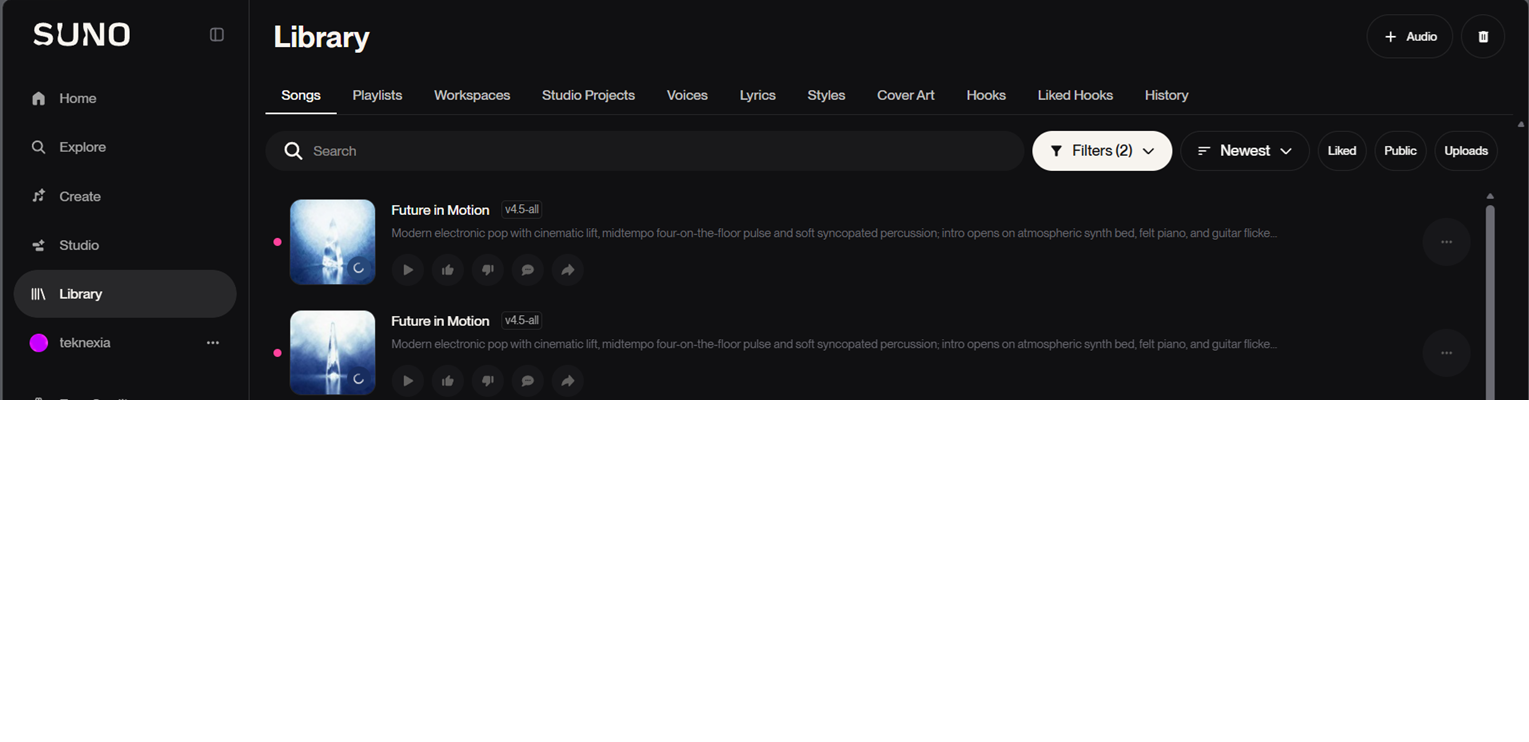
| Track library & management | — (same submission) | Track saved and organized in our account library, easy to find and replay | Straightforward |
| Stem separation / re-editing | — (same submission) | No working stem-separation path found in our account for pulling the track apart into individual elements | Real limitation for production use |
The full prompt we used, exactly as entered: “Create an uplifting cinematic electronic track about discovering new possibilities through AI and technology. Style: Modern electronic pop with cinematic elements, atmospheric synths, warm piano, subtle guitar textures and a powerful but emotional chorus. Mood: Inspirational, optimistic, futuristic, energetic but not aggressive. Structure: Intro → Verse 1 → Pre-Chorus → Chorus → Verse 2 → Chorus → Instrumental Bridge → Final Chorus → Outro. Vocals: Warm expressive male vocals, clear English pronunciation, emotional delivery. Production: Clean modern production, wide stereo image, punchy but controlled drums, rich synth layers, memorable melody. Lyrics theme: Exploring new technology, creativity, curiosity, productivity and building the future. Avoid generic AI clichés and keep the lyrics natural and human.”
Suno Studio, and what we didn't test
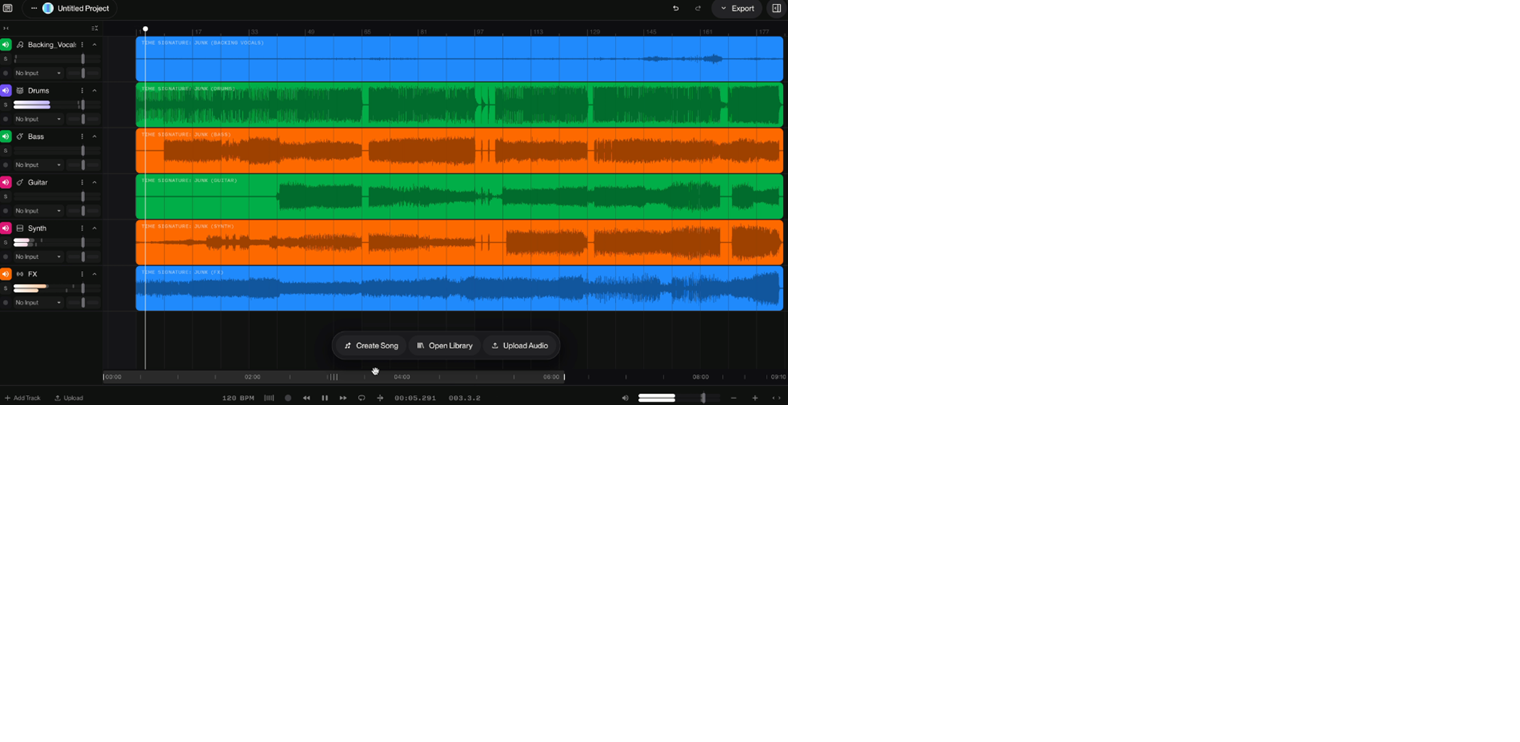
Suno's Premier plan includes access to Suno Studio, a more advanced editing environment we have not tested ourselves — our account and this test ran on the tools available below that tier. We're including a screenshot of it below for reference, sourced from Suno's own product, but we can't yet speak to how well it addresses the mixing and stem-separation gaps we found in our own test. We also haven't tested Suno's other models, voice cloning or persona features, or the free and Premier tiers directly. For those, this review leans on Suno's own documentation rather than our own use, and we'll expand it as we test more of the platform.
What Suno Actually Is
Suno is a text-to-song AI platform: describe a style, mood, structure and lyrical theme, and it generates a complete track, instrumentation and vocals included, currently on its v5.5 model for paid tiers (Suno, 2026). Beyond the initial generation, the account we tested included a library for saving and organizing tracks and an options menu on each finished song; Suno Studio, a more advanced editing environment, is reserved for the Premier plan and wasn't part of our own test.
Worth knowing before you commit lyrics or a brand name to a track: Suno has been the subject of music-industry litigation over AI training data. Warner Music Group sued Suno in 2024 and reached a settlement restructuring the relationship into a licensing partnership in late 2025; as of our research, Universal Music Group and Sony Music had not settled and were expanding their claims. This is a legal and industry story we're flagging for context, not something we investigated ourselves, and it's worth checking current status directly if it affects how you plan to use output commercially.
Suno Pricing and the Free Plan, in Detail
We verified this pricing directly on Suno's own /pricing page on 10 August 2026.
| Plan | Monthly | Billed annually | Key limits |
|---|---|---|---|
| Free | $0 | — | 50 credits/day · v4.5 model · no commercial use · shared/public creation (confirmed hands-on) |
| Pro | $10/mo | $8/mo | 2,500 credits/mo · v5.5 model · commercial use rights on new songs |
| Premier | $30/mo | $24/mo | 10,000 credits/mo · v5.5 model · Suno Studio access · commercial use rights |
The free plan, confirmed hands-on
Suno's free plan resets 50 credits every day, which is what our test account ran on. Per Suno's own pricing page rather than something we verified ourselves credit-by-credit, free-tier songs carry no commercial use rights and creation is shared/public; commercial rights only start on the Pro plan. That's a real distinction to plan around if you intend to release or monetize anything you make.
What Users Report
We want to flag a real complication here rather than smooth it over: Suno's reviews are split across at least three different Trustpilot listings (suno.com, www.suno.ai, and sunoai.ai), and the ratings we found across them vary enormously, from roughly 1.6 to over 4 out of 5. Trustpilot's own site also returned an automated bot-detection challenge when we tried to confirm any of these directly, the same block we've run into reviewing other tools. We're not going to present a single number as Suno's rating here, because the sources we found don't agree with each other and we couldn't verify any of them against Trustpilot's own page.
What we can report, cross-referenced across multiple independent sources rather than pulled from one, are recurring patterns:
- Recurring positives: vocal quality on the newer model and ease of getting a usable result quickly are mentioned often, which lines up with what we found in our own test on speed and ease of use.
- Recurring complaints: customer support responsiveness comes up as a serious, repeated complaint across sources, along with prompt instructions being ignored on some generations and difficulty maintaining voice or style consistency across versions — we didn't test support ourselves, but the editing and control limitations line up with what our own test surfaced.
What Other Users Say
We could not access Trustpilot directly to confirm any single figure, and the split itself is worth knowing: if you search for Suno reviews yourself, make sure you're reading the listing for the domain you actually plan to use. Recurring themes across sources, independent of which listing, are strong praise for vocal quality and speed, and strong criticism of customer support response times.
Sourced from multiple third-party review aggregations (retrieved 10 August 2026); Trustpilot's own pages could not be accessed directly.
Suno vs Udio
We haven't tested Udio ourselves yet, so this is an external comparison built from both companies' public pricing pages and third-party reporting, not a second hands-on test — we'll build a true head-to-head once we have our own Udio data.
| Criteria | Suno | Udio |
|---|---|---|
| Free plan | Yes — 50 credits/day, confirmed hands-on | Reported by third parties, more limited |
| Entry paid price | $8/mo (Pro, billed annually) | Reported around $10/mo |
| Downloads & commercial rights | Downloadable, commercial rights from Pro ($8-10/mo), confirmed on pricing page | Reported as streaming-only with downloads restricted since a 2025 label settlement; commercial rights reported on a higher tier |
| Vocal quality | Clear and largely convincing in our test, occasionally robotic | Not tested by us; third-party reports vary |
| Review method here | Hands-on tested | Not yet reviewed on this site |
Pros & Cons of Suno (2026)
Pros
- Simple, intuitive to use — one detailed text brief produced a complete, structured song in about a minute in our test
- Genuinely useful for musical ideation and prototyping: fast exploration of melodies, riffs, and rhythmic ideas, confirmed hands-on
- A solid starting point for a real production, not just a novelty output
- 50 free credits every day, confirmed real, with commercial rights available from $8/mo
- Track library made it easy to save, find, and replay our test generation
Cons
- Not yet suited to professional music production — our own conclusion after testing: Suno is a prototyping and idea tool more than a finished-master tool
- Mix lacked precision on our test track compared to a human-engineered master
- Vocals leaned robotic in places on our test generation, not consistently human-sounding
- No working stem-separation path found in our account — tracks are hard to rework piece by piece for a real production workflow
- Reviews are split across at least three different Trustpilot listings with wildly different ratings, and we could not verify any of them directly
Frequently Asked Questions
Does Suno have a free plan?
Is Suno good enough for professional music production?
Can you edit or separate a Suno song into individual tracks?
What's Suno's Trustpilot rating?
Our Suno Review Verdict
Suno delivers on speed and ease: one detailed brief became a complete, structured song in about a minute, and as a way to explore melodies, riffs, and musical ideas quickly, it worked well in our test. What it isn't yet, in our own direct experience, is a professional production tool. The mix on our test track lacked the precision a human engineer would bring, the vocals leaned robotic in a few places, and we couldn't find a working way to pull the track apart into stems for further work. Our honest read after testing it ourselves: Suno is more of a music ideation and prototyping tool than a finished, professional production tool. That's not a knock on what it does well — a fast, usable starting point for a real song — it's a boundary worth knowing before you expect a radio-ready master out of the box. We haven't yet tested Suno Studio, voice cloning, or the paid tiers ourselves, so treat those parts of this review as resting on Suno's own documentation until we do. This verdict is Hands-on tested for the parts we verified directly; we'll expand it as we test more of the platform.