Ideogram Review 2026: We Tested the Free Tier Firsthand


Quick Verdict
// Hands-on tested
Teknexia AI Tool Evaluation Framework
Scored from our own hands-on test of Ideogram's free tier — one real generation submitted through the live app on an active account — combined with Ideogram's public pricing page and documentation for details we didn't test directly (paid-tier limits, API/MCP). This is the canonical score for Ideogram.
Overall: 6.8/ 10
Ideogram is an AI image generation platform, best known for a claim about in-image text rendering that we haven't put to our own test yet. What we have tested directly is the free tier itself: one real, detailed prompt submitted through the live app on an active account, checked against Ideogram's public pricing page and documentation for the parts we didn't test directly (paid-tier limits, the API, and MCP integration). This review is labeled Hands-on tested for the parts we verified ourselves.
- In our own test, a detailed photorealistic prompt (a modern AI workspace desk scene) came back broadly faithful to the brief — but fine background text (handwritten notes, on-screen labels) rendered as illegible, garbled pseudo-text (Teknexia Hub testing, July 2026).
- That one generation consumed 8 of our test account's 12 available slow credits, not 4 — a free-tier user should expect roughly one to two full batches per week, not ten separate generations.
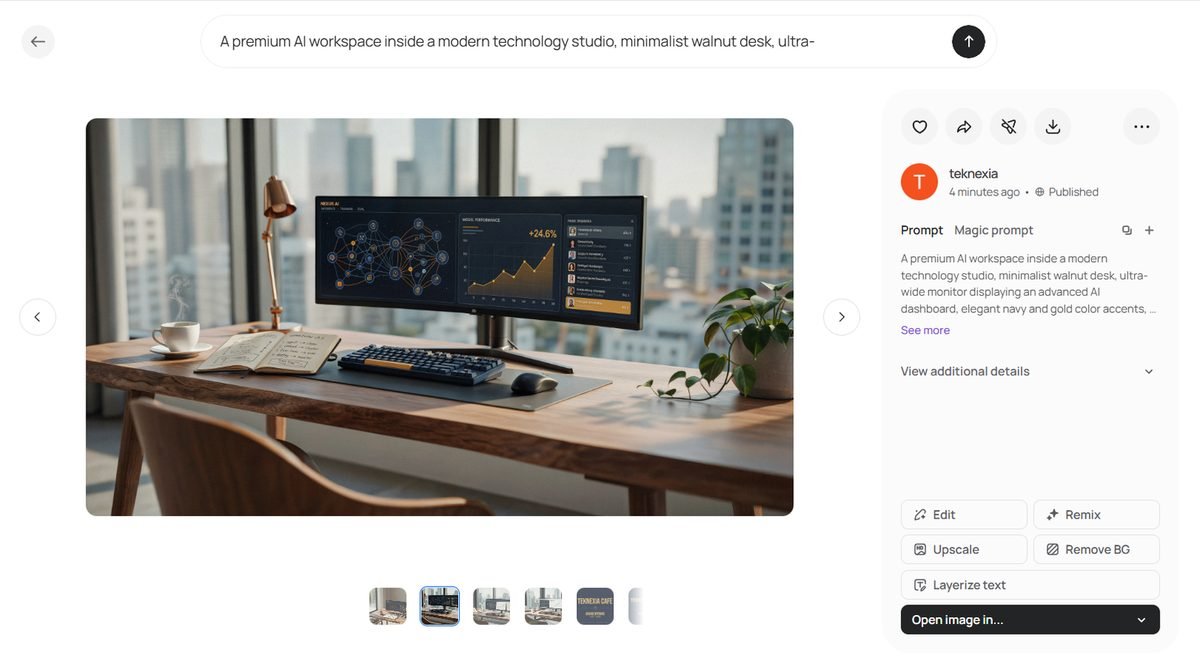
- Free-tier generations are published to Ideogram's public gallery by default, confirmed directly on our own test image ("Published" status, visible to anyone) — there's no private option without upgrading to Plus.
- Our test generation completed in under a minute this run — queue times likely vary with traffic, so don't assume that speed is guaranteed every time.
What We Tested, and What Happened
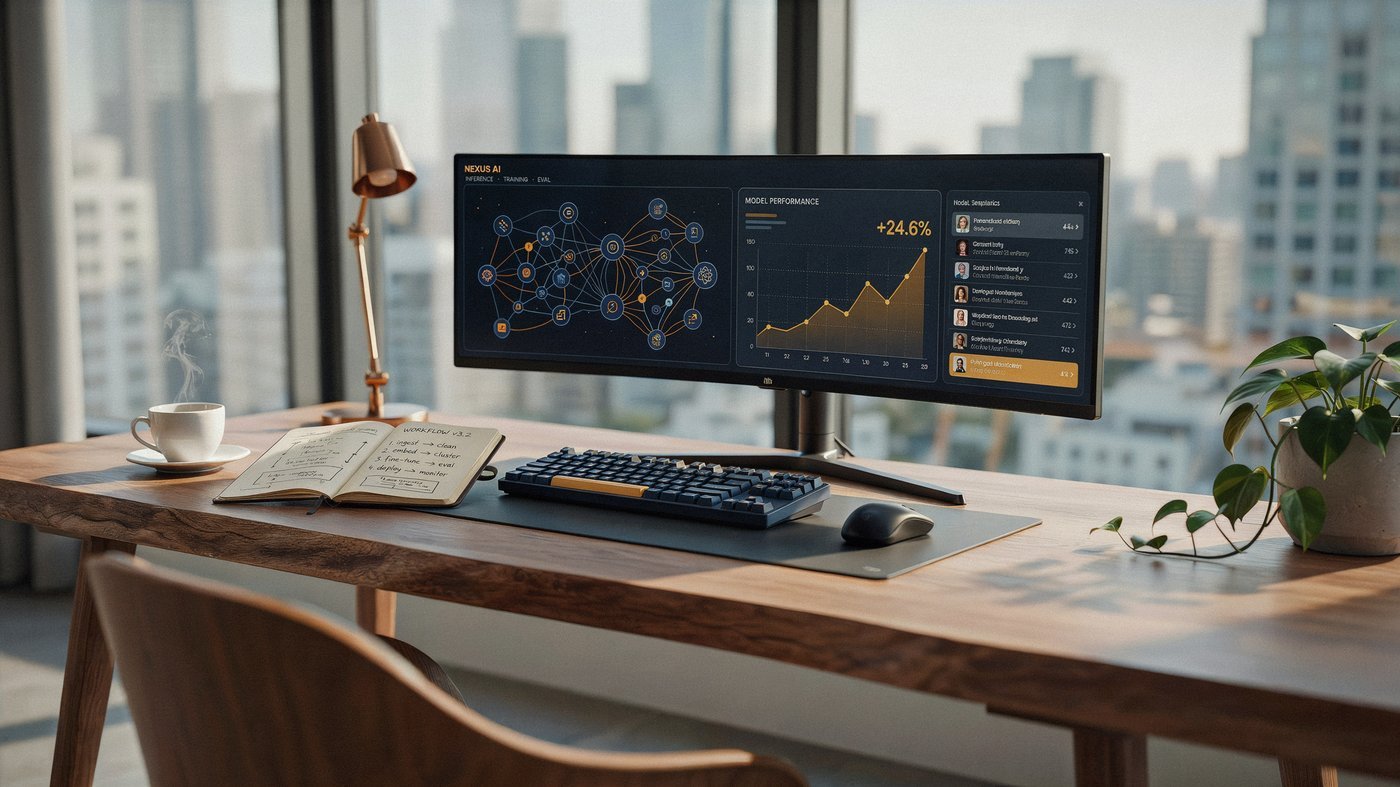
We ran this test on an active, real Ideogram account, using the free tier as most first-time users would. The account started with 12 slow credits available. We typed one long, detailed prompt into the home screen's generate box, describing a photorealistic AI workspace: a walnut desk, an ultra-wide monitor showing a dashboard, navy and gold accents, cinematic window light, and several smaller props (a notebook, a coffee cup, a keyboard).
This submission completed in under a minute — noticeably faster than the queue behavior we'd expect on a busy free tier, though a single data point doesn't tell us whether that speed is typical or just a quiet moment on Ideogram's servers. The account's credit balance dropped from 12 to 4 — the generation cost 8 slow credits for 4 images, the same rate we've seen on other test generations, not the 1-credit-per-image rate a reader might assume from Ideogram's "10 credits/week" free-plan language.
The result, pictured above: broadly faithful to the brief — the desk, monitor, lighting, and color palette all matched what we asked for, and the overall composition read as a convincing, editorial-style photograph. Looking closely, though, two background details gave the generation away: the handwritten notes in the open notebook and the small text labels on the monitor's dashboard both render as illegible, garbled pseudo-text rather than real words. It's a minor flaw in an otherwise strong result, and a specific, visible example of a known weak spot — fine text at a small scale — that we could confirm ourselves rather than take on faith. The image was automatically marked "Published" on our account, meaning it's visible in Ideogram's public gallery by default.
Generated in testing
Our Test Protocol
These notes document what we did during testing — they are separate from the 5-criteria Teknexia AI Tool Evaluation Framework score in the Quick Verdict above, not a replacement or duplicate of it.
| Test | Prompt | Result | Note |
|---|---|---|---|
| Photorealism / prompt fidelity | “A premium AI workspace inside a modern technology studio… ultra realistic, extremely detailed, HDR, 8K” (full prompt above) | Desk, monitor, lighting, and color palette all matched the brief; notebook and on-screen text rendered as illegible, garbled pseudo-text | Mostly accurate |
| Free-tier queue speed | — (same submission) | Completed in under a minute this run | Fast this time |
| Credit cost per generation | — (same submission) | 12 → 4 slow credits for one 4-image batch (8 credits, not 4) | Costlier than expected |
| Default publish visibility | — (same submission) | Image auto-marked "Published" to Ideogram's public gallery | Public by default |
What we didn't test
This one generation tells us something real about photorealistic prompt-following and free-tier mechanics, but it doesn't cover Ideogram's most-discussed claim: in-image text rendering. We haven't yet run our own dedicated text test, so that specific claim in this review still leans on third-party reporting, not our own hands-on result — we'll add that test in a future update. We also haven't tested consistency across many prompts, complex multi-person scenes, Magic Fill/inpainting workflows, Character Consistency, the API, or the MCP integration. For those areas, this review leans on Ideogram's own documentation and aggregated third-party reviews, flagged as such below.
What Ideogram Actually Is
Ideogram is an AI image generation and editing platform, currently on its "Ideogram 4.0" model, marketed around prompt fidelity, in-image text rendering, and a set of post-generation editing tools — Magic Fill (inpainting), Remix, Extend, Reframe, Upscale, and a background remover — that let you revise an image after the first generation rather than starting over (Ideogram, 2026). All of these appeared as live, clickable options on the image we generated in testing. The company also offers Ideogram 4.0 as an open-weights model on GitHub and Hugging Face, alongside the hosted app, API, and an MCP integration aimed at connecting the model to AI agents and internal tools.
The feature that shows up most consistently across independent reviews and search demand for "Ideogram review" is text rendering: multiple third-party reviews and comparison articles repeat a figure claiming roughly 90–95% legible in-image text accuracy versus roughly 30–40% for Midjourney on short phrases. That exact figure appears, worded almost identically, across many review sites — which suggests it traces back to a single original benchmark being widely copied rather than each site testing it independently. We could not trace it to one primary, reproducible source, so we're reporting it as a widely repeated claim rather than a number we've verified ourselves. What we can say directly, from our own test of a photorealistic scene rather than a dedicated text prompt: small background text (handwritten notes, UI labels) came out as illegible pseudo-text, not accurate rendering — a useful data point, though not a substitute for a real headline-text test.
Character Consistency and print-on-demand
Two features come up often in how people describe using Ideogram day to day, though we did not test either ourselves. Character Consistency lets a user upload a reference image and reuse that subject — close-ups, different poses, full-body shots — across new generations without the identity drifting each time, per Ideogram's own feature documentation. The platform also has a dedicated print-on-demand landing page marketing its text rendering specifically for merchandise, posters, and product mockups; Ideogram's site does not clearly publish the exact commercial licensing terms for reselling print-on-demand goods made from its output, so if that's your specific use case, we'd recommend confirming the terms directly with Ideogram before committing to it.
Ideogram Pricing and the Free Plan, in Detail
We verified this pricing directly on Ideogram's own site (the /pricing path redirects to the homepage, where the pricing section lives with a monthly/annual toggle) on 23 July 2026.
| Plan | Monthly | Annual | Key limits |
|---|---|---|---|
| Free | $0 | — | 10–12 slow credits/week · 1 concurrent generation · public gallery only · no image deletion |
| Plus | $20/mo | $15/mo (save 25%) | Private generation · 1,000 priority credits/mo · unlimited slow credits · 8 concurrent |
| Pro | $60/mo | $42/mo (save 30%) | 3,500 priority credits/mo · batch generation · 32 concurrent |
| Team | $30/user/mo | $20/user/mo | Everything in Plus, plus 1,500 priority credits/user/mo · central billing |
| Enterprise | Custom | Custom | Everything in Pro, plus custom models & volume API pricing |
The free plan's fine print, confirmed hands-on
Free-tier generations are commercially usable — Ideogram's FAQ states it does not claim ownership of your images and you're free to use them for any purpose, including commercial use. We confirmed the other side of that trade directly: our test generation was automatically marked "Published," meaning it's visible in Ideogram's public gallery by default, and free-tier users can't delete past generations. One thing we still could not confirm either way, despite checking the pricing page, two linked docs pages, and our own downloaded image file: whether free-tier downloads carry a visible watermark. Our own test image had none, on a single test, but we can't generalize from one generation to a hard "no" across the entire free tier.
On credits specifically: our test account showed 12 slow credits before testing, not the 10/week the pricing page describes, and a single 4-image generation used 8 of them — not 4. We can't fully explain the 12-vs-10 discrepancy from the UI alone (it may reflect a partial rollover or a cycle boundary), but the credit-per-image cost is a concrete, first-hand number worth knowing: at that rate, a free account can realistically run about one to two full 4-image batches per week, not ten single generations.
What Users Report
We want to be direct about a limitation in this section: Trustpilot returned an automated bot-detection challenge and G2 returned a 403 error when we tried to verify Ideogram's exact star rating and review counts directly. Several secondary sources cite figures for both platforms, but since we could not confirm those numbers ourselves against the primary source, we're not repeating them here as fact.
What we can report, cross-referenced across multiple independent reviews and Ideogram's own public statements, are recurring qualitative patterns — and where our own test corroborates or complicates them:
- Recurring positives: text-in-image quality and legibility (a claim we haven't independently tested with a dedicated text prompt yet), the Magic Fill/Canvas inpainting workflow (particularly for character work, which we did not test), and responsive customer support are mentioned repeatedly across the reviews we found.
- Recurring complaints: output quality described by some reviewers as inconsistent from generation to generation — our own test partly supports this, since a strong overall composition still came with garbled background text; credit expiration with no rollover; and — in Ideogram's own words, posted publicly on its X/Twitter account — slower generation queues for free-tier users during high-traffic periods, though our own test this round completed in under a minute, so we can't confirm how often the slow queue actually bites.
- A licensing debate worth knowing about: the release of Ideogram 4.0 as an "open" model drew public discussion about whether that label is accurate given its specific licensing terms — we're flagging that as an active community debate, not a settled fact either way.
We also could not find a dedicated Capterra product listing for Ideogram; it appears only as a comparison mention inside other tools' Capterra pages.
What Other Users Say
Ideogram's Trustpilot reviews are consistently positive on the same two things we found in testing: ease of use and image/text quality. The one recurring soft spot is around subscription and credit terms, where a share of reviewers describe mixed feelings about how credits are billed or consumed.
Source: Trustpilot (retrieved 28 July 2026).
Ideogram vs Midjourney
Ideogram doesn't yet have a second AI image tool published on this site to compare it against directly, so the table below is an external comparison — built from both companies' public pricing pages and the pattern of findings repeated across third-party reviews, supplemented by our own hands-on test of Ideogram alone. We have not tested Midjourney ourselves and will build a true head-to-head once we have.
| Criteria | Ideogram | Midjourney |
|---|---|---|
| Free plan | Yes — ~10-12 credits/week, public only (confirmed hands-on) | No permanent free plan |
| Entry price | $15/mo (Plus, billed annually) | From $10/mo (Basic) |
| In-image text rendering | Widely reported as a core strength (not yet independently tested by us) | Widely reported as a weaker point |
| Photorealistic / prompt fidelity | Tested by us — broadly faithful, with minor fine-detail flaws | Frequently rated stronger, per reviews (not yet tested by us) |
| Review method here | Hands-on tested | Not yet reviewed on this site |
Pros & Cons of Ideogram (2026)
Pros
- Broadly faithful photorealistic output on a long, detailed prompt in our own test — desk, lighting, and color palette all matched the brief
- Free plan includes real commercial usage rights, not just a trial, per Ideogram's own FAQ
- Low signup friction — Google, Apple, or Microsoft account, no credit card required for the free tier
- Our test generation completed in under a minute, though queue speed likely varies with traffic
- Post-generation tools (Edit, Remix, Upscale, Remove BG) were all present and usable in our test account
Cons
- Fine background text (handwritten notes, UI labels) rendered as illegible, garbled pseudo-text in our test — a real limitation on small-scale detail
- One 4-image generation used 8 of our 12 available slow credits — expect roughly one to two batches per week on the free tier, not ten
- Free-tier generations are public by default and can't be deleted — confirmed on our own test image ("Published" status)
- Whether free-tier downloads carry a watermark wasn't fully confirmable from a single test or from Ideogram's own pages
- No free trial of paid plans — only the separate free tier
Frequently Asked Questions
Does Ideogram have a free plan?
How realistic are Ideogram's photorealistic outputs?
Is Ideogram's text rendering really better than Midjourney's?
Are Ideogram's free-tier images watermarked?
Our Ideogram Review Verdict
Ideogram's free tier is more usable than it first looks, and less generous than it first looks, at the same time. In our own test, a long, detailed prompt for a photorealistic workspace scene came back broadly faithful — composition, lighting, and materials all landed — with one honest flaw: small background text rendered as illegible, garbled pseudo-text rather than real words. The free plan gives real commercial rights and the current flagship model with no card required, but our own test surfaced the practical limit fast: a single 4-image batch burns through most of a week's free credits (8 of 12, not 4), and every free generation is published to Ideogram's public gallery with no way to delete it. We haven't yet run our own dedicated test of Ideogram's headline claim — in-image text rendering — so treat that specific point as still resting on third-party reports until we do. For a creator who wants to try genuinely capable free-tier image generation and is comfortable with those trade-offs, our hands-on test points toward Ideogram being worth the free tier at minimum. This verdict is Hands-on tested for the parts we verified directly; we have not yet tested Ideogram's paid tiers, dedicated text rendering, Character Consistency, Magic Fill, or its API/MCP integration ourselves, and we'll update this review as we do.